The Day the Vision Was Put on Hold
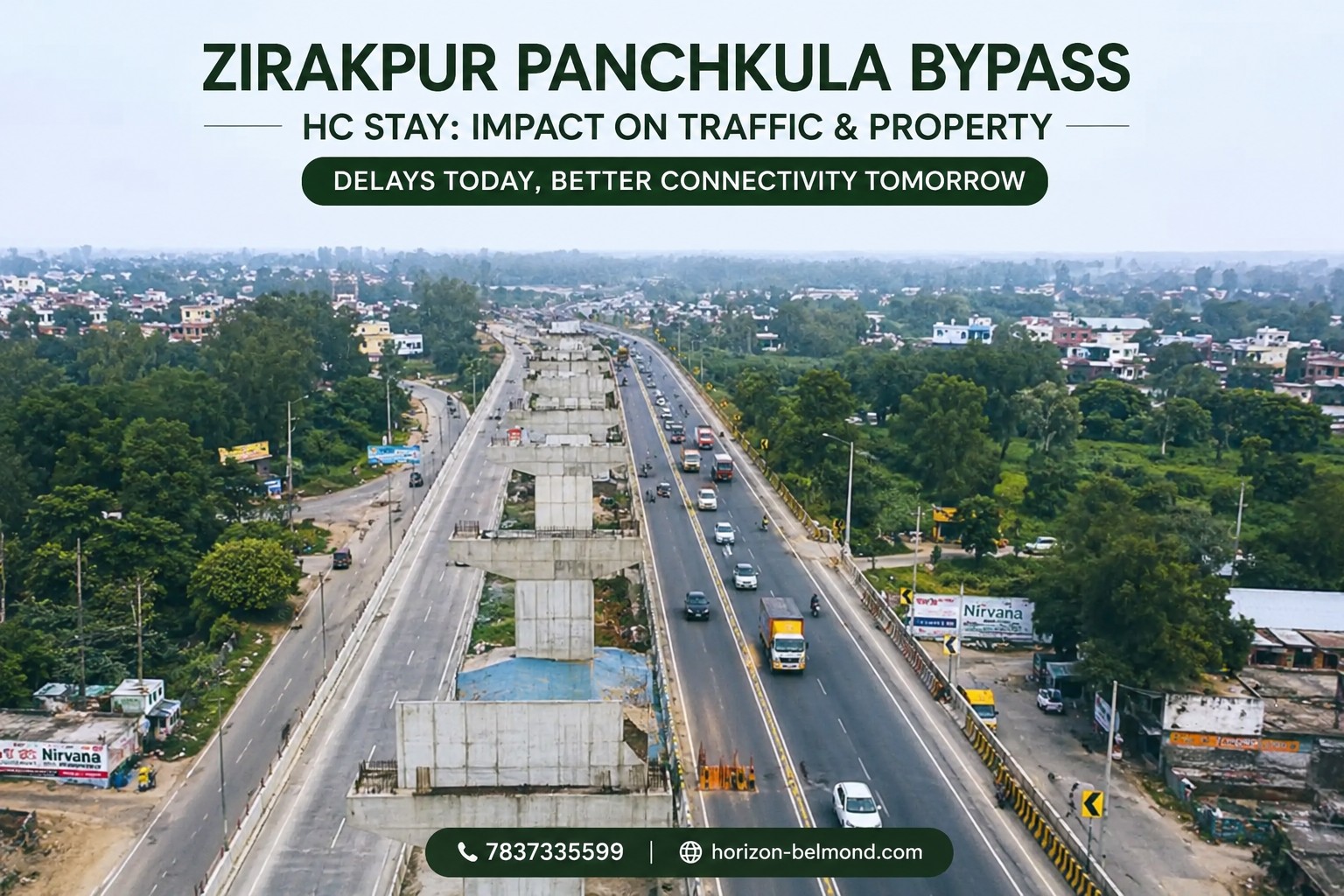
Each morning, countless residents of Chandigarh, Panchkula, Zirakpur and Mohali face the same exhausting routine - crawling through gridlocked intersections, sitting behind honking vehicles and watching another hour of their day dissolve. For years, a single project held the promise of ending that daily ordeal: the 19.2-kilometre, six-lane Zirakpur-Panchkula Bypass.
But on May 25, 2026, The Tribune published a report that shook the entire region. The Punjab and Haryana High Court issued a sweeping stay order blocking the felling of trees across the whole of Haryana without its direct authorisation - effectively freezing one of the most strategically vital urban highway projects in northern India.
The implications stretch far beyond environmental concerns. At stake are national security infrastructure, urban quality of life and the financial interests of the lakhs of families who have poured their savings into Tricity real estate.
1. The Zirakpur-Panchkula Bypass: Twenty Years in the Waiting
Picture a dedicated, access-controlled, six-lane expressway that routes all traffic travelling between Delhi, Ambala, Patiala, Shimla, Baddi and Chandigarh completely clear of Zirakpur and Panchkula's overcrowded roads. That is precisely what the bypass offers - and the reason its continued delay has become such an open wound for the region.
Conceived under the National Highways Authority of India (NHAI) within the Bharatmala Pariyojana programme, the bypass represents a Rs 1,878-crore investment in critical infrastructure. The route stretches 19.2 kilometres, incorporates a 6.195-km elevated passage through forested areas, several flyovers and a railway overbridge. Its northern origin point sits adjacent to Chandigarh International Airport - which also functions as an Indian Air Force Station - while its southern end connects to Chandimandir, Panchkula, the command headquarters of the Western Army.
| Project Parameter | Details |
| Project Name | Zirakpur-Panchkula Bypass + Greenfield Spur |
| Total Length | 19.2 km (Bypass) + 10.3 km (Spur) |
| Number of Lanes | 6-Lane, Access-Controlled Expressway |
| Total Investment | Rs 1,878 Crore (Bypass) + Rs 1,464 Crore (Spur) |
| Bypass Contractor | RKCPL Limited - Rs 1,380 Crore, 2-Year Completion Window |
| Spur Contractor | Ceigall Infra Projects Pvt. Ltd - Rs 603 Crore, 18-Month Window |
| Origin Point | Near Chandigarh Airport / IAF Station |
| Terminus | Chandimandir, Panchkula (Western Army Command HQ) |
| Governing Authority | NHAI under Bharatmala Pariyojana |
| Forest Clearances | Stage-I & Stage-II from MoEF&CC - Already Secured |
| Defence Land Clearance | 2.7461 Acres at Chandimandir - Approved (May 2026) |
2. The High Court Stay - What Precisely Unfolded?
Within weeks of NHAI clearing every significant regulatory milestone - including the pivotal Ministry of Defence approval for 2.7461 acres of army land at Chandimandir Military Station - the Punjab and Haryana High Court issued an order that abruptly suspended ground-level activity on the project.
Triggered by a Public Interest Litigation (PIL), the court's directive is far-reaching: it prohibits the cutting of trees anywhere in the state of Haryana without explicit judicial clearance. The petitioners alleged that approximately 5,000 trees stood to be felled along the bypass corridor. NHAI, in its detailed response to the court, put the actual number of forest trees earmarked for removal at 2,790 - a figure significantly lower than the PIL's claim.
COURT STATUS AT A GLANCE The Punjab and Haryana High Court has prohibited tree felling - including roughly 5,000 trees cited along the bypass route - across the entire state of Haryana without its express consent. - The Tribune, May 25, 2026
Case Status: Awaiting next scheduled hearing Court Direction: No tree felling permitted without judicial approval PIL Claim: Approx. 5,000 trees to be removed along the corridor NHAI's Position: Only 2,790 forest trees proposed for felling - all under valid statutory clearances |
3. The Numbers Behind the Trees - NHAI's Environmental Case
The central question before the court is whether the proposed tree removal is warranted and whether it has been sanctioned through proper legal channels. Here is NHAI's declared position as submitted to the High Court:
| Environmental Measure | NHAI's Declared Figure |
| Forest Trees Proposed for Removal | 2,790 (not ~5,000 as claimed in PIL) |
| Statutory Forest Clearances | Stage-I & Stage-II obtained from MoEF&CC, Govt. of India |
| Wildlife Impact Assessment | Reviewed and cleared by the Wildlife Institute of India, Dehradun |
| Compensatory Afforestation (Statutory) | 27,770 trees under official schemes |
| Avenue Plantation Along Bypass | 12,000 trees |
| Shrubs Within the Corridor | 7,992 shrubs |
| Total New Plantings Committed | 47,762 - over 17 times the trees to be removed |
| NPV & Afforestation Funds | Already deposited with MoEF&CC, Govt. of India |
| Elevated Corridor Design | 6.195 km elevation specifically to reduce tree removal |
In plain terms: for every tree that needs to be removed, NHAI has pledged to plant more than 17 in its place. The project has further been engineered - at considerable extra expense - with an elevated section through the most tree-dense stretches to keep the removal count as low as possible.
FACT CHECK Does NHAI hold valid forest clearances? YES. Both Stage-I and Stage-II approvals have been secured from the Ministry of Environment, Forest and Climate Change. Is compensatory planting in place? YES. Over 47,000 new plantings are committed against 2,790 trees - a ratio exceeding 17:1. Was an independent wildlife review conducted? YES. The Wildlife Institute of India, Dehradun assessed and approved the Wildlife Mitigation Plan. |
4. Why Was the PIL Filed? Understanding the Ecological Concerns
The citizens behind the PIL are not acting in bad faith - they represent a legitimate and growing anxiety about the pace at which green cover is being erased across the Tricity. The Shivalik foothills flanking Panchkula and the Morni Hills are among the last remaining natural forest belts in an increasingly built-up region. Every kilometre of highway carved through these forests carries consequences that cannot easily be reversed.
The petitioners' concerns are rooted in a familiar pattern: infrastructure projects announced with ambitious replanting commitments that frequently fail to materialise at the promised scale or within the promised timeframe. The gap between the PIL's tree count (5,000) and NHAI's figure (2,790) also points to a lack of a single transparent, publicly accessible ground-level count - a governance shortfall that justifiably invites judicial attention.
It is also worth noting that the HC's order is not restricted to this bypass. Its direction covers all tree felling in Haryana - signalling a broader concern about the speed of forest diversion approvals across the state. While that concern is legitimate, it risks creating unintended consequences for projects that have genuinely complied with the law.
5. Why This Project Cannot Be Deferred - The Strategic Dimension
Framing this as merely a congestion-relief project would be a significant understatement. The Zirakpur-Panchkula Bypass carries a dimension that transforms it from a regional convenience into a matter of national security.
5.1 The Defence Corridor Angle
The bypass begins near Chandigarh International Airport - which doubles as an Indian Air Force Station - and concludes at Chandimandir, Panchkula, the headquarters of the Indian Army's Western Command. Once operational, this corridor will deliver a congestion-free, access-controlled route for the rapid movement of defence personnel, equipment and supplies between two critical national security installations.
In a border state where rapid military mobilisation may become necessary at short notice - as recent geopolitical developments have repeatedly underscored - this is not a peripheral benefit. It is a core national security asset. At present, all routes between these two establishments pass through dense residential and commercial zones with multiple junctions, materially slowing transit and emergency response times.
5.2 The Daily Commute Dimension
Zirakpur is today the single most congested point in the entire Tricity. Every vehicle travelling from Delhi, Ambala or Patiala towards Panchkula, Shimla, Baddi or Chandigarh must navigate its narrow, overloaded road network - a town whose streets were never designed to carry national-highway-level traffic. During peak hours, commuters routinely lose 20 to 30 minutes at this bottleneck alone.
The bypass will allow all transit traffic to completely bypass Zirakpur and Panchkula, dramatically cutting journey times, reducing fuel-wasting idling and easing the chronic gridlock on NH-44, NH-205A and NH-152.
5.3 The Economic Cost of Delay
Delays have a price. The Spur project alone has seen its estimated cost balloon from Rs 940 crore to Rs 1,464 crore - an increase of nearly 56% - over the years since it was first conceived in 2020. Rising construction material costs, labour inflation and land acquisition expenses continue to compound. Each court date that extends the stay is not a cost-neutral pause; it is a tangible financial burden ultimately borne by ordinary taxpayers.
6. A Project That Has Already Waited Long Enough - The Timeline
| "Every year of delay is not simply a lost year of infrastructure. It is a year of pollution inhaled, accidents on congested roads and mounting costs that ordinary citizens ultimately absorb." |
| Period / Date | Key Milestone |
| 2020 | Project conceptualised under Bharatmala Pariyojana |
| 2020-2024 | Extended wait for forest clearances, land acquisition and regulatory approvals |
| June 2025 | Fresh tenders issued by NHAI; technical bid openings postponed six times |
| January 2026 | Final Stage-2 Forest Clearance received from MoEF&CC |
| January 29, 2026 | Technical bids opened; contract awarded to RKCPL Ltd & Ceigall Infra |
| February 2026 | Spur (Rs 1,464 Cr Greenfield Corridor) approved by Central Government |
| May 2026 | Ministry of Defence clears 2.7461 acres of Army land at Chandimandir |
| May 25, 2026 | Punjab & Haryana HC issues blanket stay on tree felling in Haryana (PIL) |
| Current Status | Project suspended pending HC hearing; NHAI reply submitted |
7. The Ripple Effect on Tricity - Who Pays the Price?
The HC stay does not simply pause a highway contract. Its effects radiate outward, touching the lives of millions of people across the region.
7.1 Traffic and Daily Commuting
• Zirakpur's key intersections - Gol Market, Kalka Chowk, VIP Road - will continue bleeding commuter time daily.
• Heavy freight vehicles from Delhi, Ambala, Patiala and Shimla-bound routes will keep choking residential and commercial streets.
• Air quality in Zirakpur and Panchkula's micro-markets will remain poor due to sustained vehicular idling.
• Emergency vehicle access to hospitals like Fortis Mohali and PGIMER Chandigarh will remain critically compromised during peak hours.
7.2 Business and Commerce
• Logistics operators serving the Baddi-Barotiwala-Nalagarh industrial belt will continue absorbing freight delays and cost overruns.
• Commercial property near anticipated bypass exits - which had been expected to see significant footfall growth - will remain in a holding pattern.
• Retail businesses along the projected corridor will postpone expansion decisions.
7.3 The Tricity Ring Road
The bypass is not a standalone endeavour. It forms a vital 19.2-km segment of the 244-km Tricity Ring Road - a transformative infrastructure vision that links Chandigarh, Mohali, Panchkula, Zirakpur, Ambala and the airport in one continuous loop. A block on this section leaves the Ring Road's full vision incomplete, delaying the network-wide benefits it would otherwise generate.
8. The Property Market Impact - What Happens to Values?
At Homziio, with more than 500 completed projects and two decades of active engagement with buyers, investors and developers across the Tricity, we track infrastructure developments not merely as headlines - but as the single most powerful lever of real estate value. Here is our candid read of the situation.
8.1 What the Bypass Had Been Promising for Real Estate
• Zirakpur properties within 1 to 2 km of proposed bypass exits were seeing speculative price increases of 12 to 18% through 2025-26.
• Panchkula Sectors 26-28, Dhakoli and the New Panchkula fringe were drawing institutional investor interest as bypass-corridor hotspots.
• Commercial land near proposed interchange points along Chandigarh Airport Road was commanding asking prices of Rs 17,000 to Rs 20,500 per sq. ft.
• Luxury residential developments in Mohali Sectors 66-70 and Zirakpur's VIP Road corridor were projecting appreciation of 15 to 20% upon bypass completion.
8.2 How the Stay Is Affecting Sentiment
The HC order introduces what the industry refers to as 'regulatory overhang' - an atmosphere of uncertainty that makes buyers hesitant and sellers reluctant to negotiate. In the near term:
• Investors who acquired land or apartments in anticipation of bypass-driven appreciation are likely to adopt a watch-and-wait stance.
• New launches in Zirakpur and along the NH-152 corridor may be pushed back by one to two quarters.
• Institutional capital earmarked for Tricity commercial real estate could temporarily be redirected towards Gurugram or Noida.
HOMZIIO'S ADVICE TO BUYERS If you are purchasing a home for your own occupation in Zirakpur, Panchkula or Mohali, the HC stay changes nothing fundamental. The bypass will be built. NHAI holds every clearance required. The only open variable is timing. For investors, the current moment represents a point of entry: prices have stabilised temporarily and buying ready-to-move inventory today positions you for appreciation when construction eventually commences. Always consult a Homziio advisor before committing. Past performance of infrastructure corridors does not guarantee future returns. |
9. Development Versus Environment - A Conversation Tricity Cannot Sidestep
This is not a clear-cut debate and presenting it as one would be intellectually dishonest. The HC stay has compelled a conversation that the Tricity has long needed to have - what kind of urban region do we collectively want to build?
| The Case for Development | The Case for Environmental Protection |
| National security corridor connecting IAF Station and Western Army HQ | Shivalik foothills are among the last natural forest buffers remaining in Tricity |
| 2,790 trees to be removed, offset by 47,762 new plantings (17:1 ratio) | Compensatory plantation rarely replicates the ecological value of mature forest trees |
| All statutory clearances (Stage-I & II) secured from MoEF&CC | PIL identifies a discrepancy: 5,000 vs 2,790 - absence of transparent public data |
| 6.195 km elevated design specifically minimises tree removal | Precedent risk: approving this project sets a template for future forest diversions |
| 56% cost escalation per year of delay - borne by taxpayers | Urban heat, flood risk and air quality already at critical levels in Panchkula |
| 244-km Tricity Ring Road cannot be completed without this link | Judicial oversight is the last meaningful check before irreversible ecological damage |
The most constructive resolution would be for the HC to authorise a transparent, third-party verification of the actual tree count, expedite an independent assessment of NHAI's compensatory plantation commitments and issue a time-bound order rather than an indefinite stay. The forest deserves protection. The commuters deserve relief. Both outcomes are achievable - but only through speed and transparency, not prolonged legal proceedings.
10. What Happens Next - The Road Ahead
As of the date of publication, the case remains listed before the Punjab and Haryana High Court. The following are the most plausible scenarios, based on our assessment:
| Scenario | Our Probability Assessment |
| HC vacates stay following NHAI compliance demonstration | High - NHAI's comprehensive reply strengthens its legal position |
| HC allows limited, monitored tree felling | Moderate |
| HC directs an independent tree count exercise | Moderate |
| Extended litigation lasting 6 to 12 months | Low, though possible |
| Full project ban | Very low - statutory clearances are firmly in place |
NHAI's legal footing is solid: both Stage-I and Stage-II clearances are in hand, the Wildlife Institute of India has vetted the ecological mitigation plan, afforestation funds have been deposited and the project design already reduces tree loss through elevation. The most probable outcome is a conditional clearance from the HC, likely accompanied by enhanced monitoring requirements for compensatory plantation.
11. A Word from Homziio - Because Context Matters
Since 2004, Homziio has been more than a property listing platform. We serve as a research partner, a market guide and an honest voice in a sector where hype frequently drowns out facts. When infrastructure news of this magnitude breaks, our clients deserve clarity - not alarm, not uncritical optimism.
The Zirakpur-Panchkula Bypass is among the most thoroughly cleared and meticulously planned infrastructure projects in the Tricity's history. It has endured bureaucratic delays, cost escalations, protracted forest clearance battles and complex defence land negotiations. The current HC stay is a legal checkpoint - not a project-ending verdict. Historical precedent consistently shows that well-cleared NHAI projects ultimately proceed. The only question is when.
Our counsel to the Tricity real estate community: remain informed, remain patient and remain invested in fundamentals. The Tricity - with its unique triple-governance advantage (Chandigarh UT + Punjab + Haryana), its proximity to Delhi-NCR, its quality-of-life benchmarks and its infrastructure pipeline - remains one of North India's most resilient property markets. |
Conclusion: Trees, Concrete and the Tricity's Future
At its core, this is a story about a society attempting to reconcile two competing imperatives - the drive to build fast in an era of geopolitical uncertainty and urban overcrowding and the imperative to safeguard the natural systems that make cities worth living in.
The HC intervention has brought into sharp focus the governance gaps, the shortage of public data transparency and the institutional distrust that compels citizens to turn to courts when regulatory agencies should have earned their confidence. Every party involved - NHAI, the petitioners, the High Court, the state government and the citizens of the Tricity - must now move with both urgency and good faith.
The 2,790 trees at stake deserve a proper hearing. So too do the lakhs of daily commuters, the defence establishments at either end of the corridor and the families whose savings and daily lives depend on this project. As proceedings unfold, Homziio will bring you every verified update - because the moment this matter is resolved and construction finally begins, the Tricity will experience one of its most significant infrastructure transformations in a generation.